
HARBOR WETLANDS
at the Baltimore National Aquarium


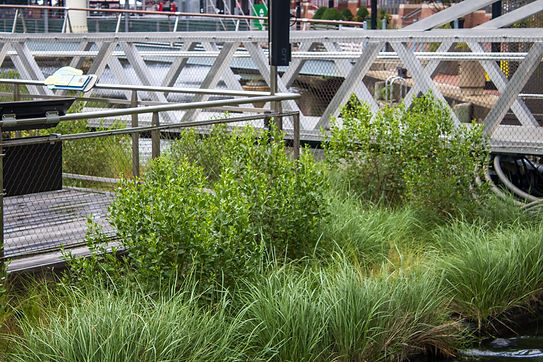
The harbor wetland
Harbor Wetland is a free outdoor exhibit at the National Aquarium in Baltimore that recreates the city’s historic salt marsh habitat on floating docks between Piers 3 and 4. Using breakthrough technology, it blends conservation and public education by showing how wetlands naturally filter water, support biodiversity, and help inspire a healthier Inner Harbor.
The exhibit is built on a large scale — about 10,000 square feet — and uses more than 32,000 native grasses and shrubs, making it both a green infrastructure project and a living habitat. Since opening in 2024, it has attracted a wide range of wildlife, including birds, fish, reptiles, crustaceans, and even mammals, turning the waterfront into a small urban ecosystem.
It’s also designed to be practical and visitor-friendly: people can walk onto the floating docks, observe the habitat up close, and learn how restoring wetlands can improve water quality and bring native species back to the harbor.
We had the chance to interview Taylor Long, a Conservation Coordinator at the national aquarium, about Harbor Wetland. Taylor is responsible for routine maintenance on Harbor Wetland in Baltimore's Inner Harbor, giving her a close look at its resident wildlife. Read the interview below!
Olivia: In your own words, what is the purpose of the Harbor Wetland?
Taylor: The Harbor Wetland really provides a small amount of microhabitat back into an area that is just very hard cityscaped. Over 200 years ago, this area would’ve been a salt marsh habitat, so Harbor Wetland is just trying to bring back a little bit of that habitat. But also, in doing that, we are able to provide green space into a city that doesn’t have a lot of green space.


Sam: Are there any special facts you have about it, or a favorite aspect of it?
Taylor: I mean, I think my favorite thing about Harbor Wetland is just how quickly wildlife moved into the area. And I mean, I say “moved in,” but realistically, all these animals were already here; they just didn’t have a space to really thrive or be seen. So when we were planting Harbor Wetland, before it was actually even fully submerged into the water, we had a pair of mallards nest on the wetland. So they moved very quickly. And then our first sighting of the North American river otter was the first June it was open, so a little over a year ago. I think that’s just really exciting; that we brought in even charismatic wildlife like that so quickly.
Olivia: That’s awesome! So how does the Harbor Wetland connect with larger conservation goals across the Chesapeake, whether that’s for the Aquarium specifically or for the city as a whole?
Taylor: I think the biggest key takeaway for that is that Harbor Wetland is kind of like a pioneer in this type of technology. Floating wetlands, in general, are used as a best management practice in stormwater retention ponds... So I think the most important part of Harbor Wetland is that we were able to do it and that it’s seemingly so successful. You know, we have to actually quantify that with research, and we’re not even a year into it, so we just need time on that. But other organizations are seeing that and are interested in doing their own wetlands to improve and create more. We absolutely are working with other organizations. We currently have two projects in the works—very early stages, like contract-writing phases—but we have two where people are very, very interested in creating their own wetlands. So we would basically act as consultants, letting them know, “Hey, here’s what worked really well, here’s what didn’t work so well,” and then hope those relationships grow to the point where they actually build their own wetland. So I think that’s the most important aspect—just sparking that inspiration for others to do similar things.


Olivia: Speaking of quantifiable research, do you have measurable ecological impact of the wetland? Are you able to measure dissolved oxygen in surrounding areas? Is there any sign of improvement there?
Taylor: Yeah, so that’s something we are certainly doing right now. The National Aquarium conservation department does not have a “research department,” per se, so we do a lot of the data collection and store the data—we’ll put it into Excel sheets, organize it—but then from there, to have someone actually do a paper and conduct research on it, we usually partner with other organizations. One of the big partners we work with is IMET across the street. So we do have 10 years of historical water quality data in this area, and then with Harbor Wetland, we now have additional stations that we are monitoring on top of our old stations. Since it’s so new, it’s still too early to tell if it’s making an improvement or not, but with that data and those years of research, we can certainly make comparisons.
Sam: So similarly to dissolved oxygen, are you seeing any sort of impact in those measurements that you’re taking, or the nitrogen levels—stuff like that?
Taylor: We measure dissolved oxygen, temperature, salinity, and chlorophyll. We don’t currently measure nitrogen or phosphorus, so I can’t really speak to that yet. But again, if any organization reaches out to us wanting to pursue that research, then we will happily work with them. As far as the measurements that we are taking, one of the biggest examples that we have is the fish kill that happened last year. So last September, we had a thermal inversion event, which essentially creates a big bacterial bloom... making the water very oxygen-poor. So our stations around the Inner Harbor were showing extremely low, basically anoxic levels. Harbor Wetland was still very low, but it was livable. We also made physical observations just by being there at the moment, and one of the things we did observe is that a lot of the fish that were affected by this in other areas of the harbor were at the surface gulping for air, which is a sign of stress. In Harbor Wetland’s shallow channel, the fish were acting normal, so we didn’t see any of that gulping behavior. Even just actually watching what was happening, we saw a difference.


Olivia: Awesome. Speaking of partnering with research organizations—kind of moving away from research but still staying in that same realm—are you partnering with any other organizations to increase the impact that Harbor Wetland has on surrounding communities, like schools?
Taylor: Yeah! We have a lot of different programs here. One of the other departments that works at the Aquarium is the conservation education department, and they have a program called What Lives In The Harbor? That is a program that all sixth-grade city students participate in. It’s more than just one visit to the Aquarium—there are classroom components that the teachers build into their programs throughout the year. So that’s one aspect of community outreach. The other: we do partner with organizations like Blue Water Baltimore, IMET, Johns Hopkins, and others. Even just getting the word out with those organizations and having that relationship really helps, because it creates a really strong network of people.
Olivia: You’ve done a lot to make this exhibit accessible—it’s free to the public, it’s right there next to the Aquarium—but how are you hoping that this will inspire local city dwellers to engage in conservation? And if you have any recommendations for engaging?
Taylor: So, the signage out there—you know, we can’t force people to read—but a lot of people seem very interested in it. It is very intentionally worded and placed on the wetland so it kind of takes you on a journey through time. The beginning portion of the wetland is all about what used to be here: what did this look like before the city was here? What is a salt marsh? That kind of thing. Then the middle is, what is this? Why is this here? What’s going on right now? And then the ending portion is the future—how can you help, and what is the future of Baltimore? So that’s one kind of self-guided way that Harbor Wetland can help people be inspired to take their own actions. The other part of that is we do have an education team that spends a lot of time out there, and that’s one of their big goals—to inspire people through conversation to want to take action, whether it’s something really simple at home like switching to reusable items, or something more involved like engaging in community efforts such as leading cleanups or doing native garden plantings.


Sam: That’s really cool! How was your journey to getting involved here, and what inspired you to work with the Aquarium?
Taylor: So, through college, I did a capstone project and worked with the conservation department at the National Aquarium on that. It was mostly about oysters on the floating wetland prototype and how the water quality in that area compares to other areas of the harbor. So that’s how I kind of built my relationships here. And then, when I graduated—as anyone in this field probably knows—looking for a job is really, really hard. So it took me two years to actually get back here at the Aquarium. I started in our guest engagement department, so I was a front-facing educator doing talks and things like that. I always knew I wanted to do more on the conservation side of things, so once this position opened up, my background in already working with floating wetland technology really gave me a good foot in the door and a strong head start.
Sam: Cool, cool, cool. Any final comments about the Harbor Wetland? Anything you’d want someone to take away?
Taylor: I think the biggest thing I really appreciate about Harbor Wetland—we kind of touched on this already—is that it’s really inspiring and really important. This is a big city with not a lot of green space, and the green space that is available isn’t always accessible to everybody. So having Harbor Wetland here really creates that sense of hope. And hopefully other organizations—it doesn’t even have to be a floating wetland; they cost millions of dollars—will be inspired to want to learn more or do more.
