
White Tailed Deer

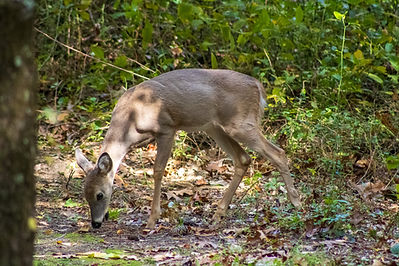
White-tailed deer are one of those animals that feel inseparable from everyday life in Maryland. You don’t need to go far into the wilderness to see one. Sometimes they appear at the edge of a backyard at dusk, sometimes they pause mid-trail as if just as surprised to see you as you are to see them. For me, deer have always been a quiet constant: in the background of childhood visits, neighborhood walks, and summer adventures.
What Deer Eat and How They Digest It
White-tailed deer are herbivores with impressively flexible diets. They feed on nuts and berries, leaves, grasses, woody shoots, and stems, adjusting what they eat based on what’s available throughout the seasons. Some of their favorite natural foods include acorns, honeysuckle, poison ivy, green briar, young tree seedlings, and mushrooms. They’re also quick to take advantage of human-planted foods like soybeans, corn, and ornamental shrubs, which partly explains why they’re so comfortable living near people.
To survive on a diet made almost entirely of vegetation, deer rely on a specialized four-chambered stomach. Food enters the first chamber, the rumen, where bacteria and protozoa begin breaking down tough plant material. It then moves to the reticulum, which sends partially digested food back to the mouth so the deer can chew it again, since I guess they couldn’t do it right the first time (similarly to me with math homework). From there, the omasum regulates and moves food along to the abomasum, which functions much like a human stomach and completes digestion. Because this process depends on a delicate balance of microbes, feeding deer can actually do more harm than good by disrupting their natural digestion, especially in winter when food is less abundant and counts all the more.
Where Deer Thrive in Maryland
White-tailed deer occupy almost every corner of Maryland, with the exception of open water and the most intensely developed urban areas, like downtown Baltimore. They do best in landscapes that mix wooded or brushy areas with open spaces such as fields, cropland, or even landscaped yards. Forested areas provide cover and safety, while open areas offer abundant food.
This combination, known as “edge habitat,” where forest meets open land, creates ideal conditions for deer. Ironically, suburban development often increases this kind of habitat. When forests are partially cleared for housing or farmland transitions into residential neighborhoods, the result is a patchwork of lawns, gardens, shrubs, and remaining woods. From a deer’s perspective, it’s close to perfect.
I’ve seen this firsthand. Growing up, and still today, deer regularly pass through my grandparents’ property in Parkton, especially in the early morning and evening. I’ll sometimes spot them while walking my dog along the short trail in our neighborhood, standing just beyond the path before melting back into the trees. Last summer, deer seemed to follow us everywhere—from St. Mary’s Park to Patapsco River State Park—quietly reminding us how adaptable and widespread they are.


When Abundance Becomes a Problem
While deer are an essential part of Maryland’s ecosystems, their success has created challenges. In areas where natural predators are scarce and edge habitat is abundant, deer populations can grow beyond what the land can support. Overgrazing can damage forests by preventing young trees and native plants from regenerating, which in turn affects birds, insects, and other wildlife that depend on healthy understories.This is where hunting enters the conversation—not as a sport divorced from ecology, but as a management tool. In Maryland, regulated deer hunting is used to keep populations at sustainable levels, reduce vehicle collisions, limit the spread of disease, and protect forest health. Managed responsibly, hunting plays a role in maintaining balance between deer, their habitat, and the many other species that share the landscape.

Why Deer Are So Dear to Us
Living alongside deer means learning to notice the ecosystems we’re already part of—backyards, trails, parks, and all. Their presence is a reminder that wildlife doesn’t only exist in distant wilderness. Sometimes, it’s right outside the door.
